HeadWaters Conservancy completes
largest property protection to date
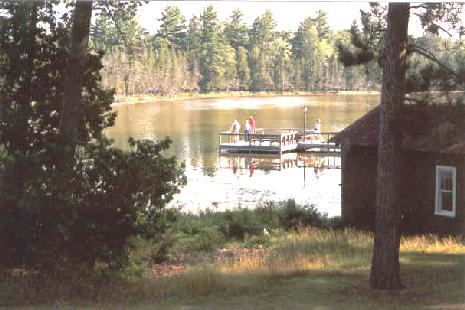
Photo by Steve Qua
A spectacular 450-acre lakefront property with prime
black bear and bobcat habitat in Presque Isle County will be
preserved forever, thanks to the vision and generosity of the
landowners, who donated a conservation easement on the parcel to
HeadWaters Land Conservancy. “With the rapid development and changes
occurring in northern Michigan, this will leave a lasting footprint
and legacy for our kids and grandkids where you can still hear loons
and coyotes” said the landowners, who wish to remain anonymous.
This project was started in 2002 and is a key parcel
in the Conservancy’s Big Lands initiative, which protects large
tracts of hunt club, farmland and family lands in this wild and
remote region of northern Michigan. The land, which is rolling,
wooded and covered with stands of 100-year old Jack Pine and White
Pine, is a large enough unbroken tract to be home to a diverse
population of wildlife, including loons, white-tailed deer, black
bear, bobcat and elk. “The feeling you have when you are on this
magnificent property, with its nostalgic cabins, main lodge with the
stone fireplace, and undeveloped lake shore, is that you are in an
era gone by - that you are back in time. It is a wonderful gift to
wildlife and those who appreciate wilderness that the landowners
have protected this amazing property”, said HeadWaters Land
Conservancy’s Director of Development Kirt Manecke.
A conservation easement is a voluntary legal
agreement that allows a landowner to permanently protect land and
limit future development in order to protect the conservation values
of the land, while retaining ownership and the ability to sell.
Because they are practical, very flexible, and offer tax benefits to
many landowners, conservation easements have been used to preserve
over 1.5 million acres of natural and agricultural land across the
country. Most conservation easements are perpetual, and hold all
future owners of the land under easement to the terms of the
agreement. Likewise, land trusts that hold perpetual conservation
easements are obligated to permanently monitor and enforce those
easements. Private land that is protected with conservation
easements is not open to the public.
Building envelopes for a future homesite for future
generations can be built into the conservation easement agreement
outside the conservation easement boundaries as long as they do not
disrupt the conservation values of the property. Hunting and
sustainable forestry are allowed if the landowner wishes and are
evidence of the easements incredible flexibility. Conservation
easements that meet the requirements of the tax code could be
eligible for an income tax deduction and are beneficial in lowering
estate taxes.
Based in Gaylord, HeadWaters Land Conservancy is a
non-profit land conservancy established in 1993 to protect land in
the eleven-county region of northeast Lower Michigan. These counties
include Alcona, Alpena, Arenac, Crawford, Roscommon, Iosco,
Montmorency, Ogemaw, Oscoda, Otsego, and Presque Isle County.
HeadWaters Land Conservancy works to conserve the “Up North” you
enjoy by protecting open space, waterfront, wildlife habitat and
farmland in Northeast Michigan. HeadWaters Land Conservancy has
protected more than 1,850 acres, with another 1,000 acres in
process. For more information, please contact HeadWaters Land
Conservancy.